
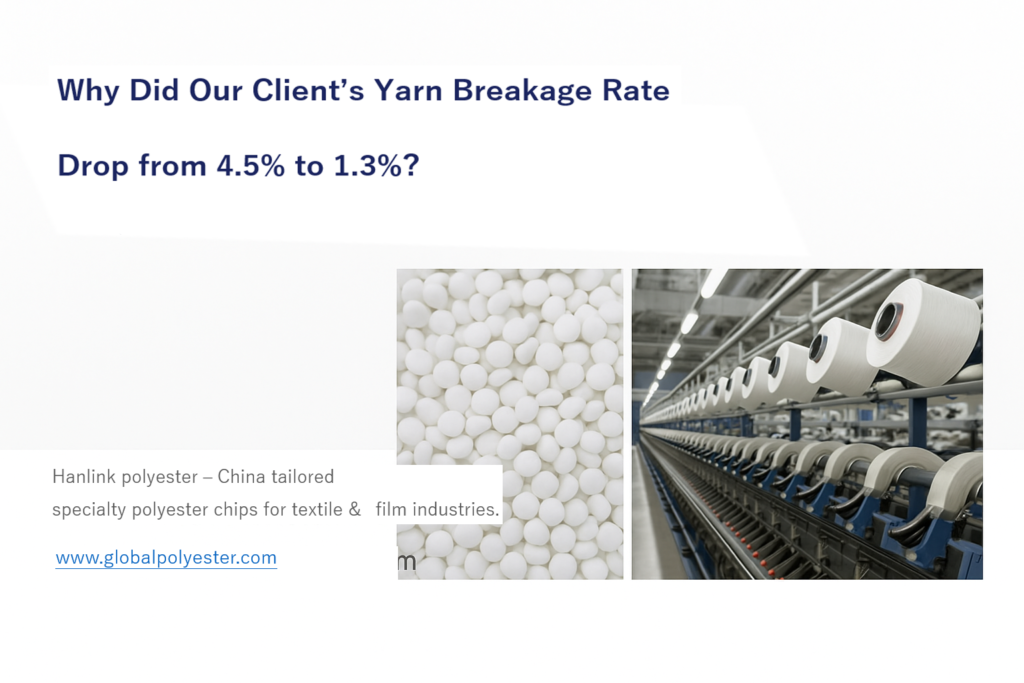

At HanLink Polyester, we focus on developing high-performance functional PET chips. In recent years, more and more customers ask us the same question:
“Are you using ethylene antimony? Why is spinning so smooth?”
It’s time to explain why.
1.Why Do We Use Ethylene Antimony?
A. Unstable reaction rate, which caused long poly time and IV fluctuations.
B.Poor impurity control, leading to color issues and bad spinnability.
In the past, most factories used antimony trioxide or antimony acetate as polycondensation catalysts. But these old catalysts had two big problems:
Since 2021, we switched fully to ethylene antimony. It’s a third-generation antimony catalyst. It shows high catalytic power and excellent solubility.
Here’s a comparison:
| Catalyst Type | Antimony Trioxide | Antimony Acetate | Ethylene Antimony |
| Sb Content (wt%) | 99.8% | 43.6% | 57% |
| Solubility in EG | Poor | Medium | Excellent |
| Poly Time | 3.5 hrs | 3.2 hrs | 2.6 hrs |
| IV Stability | ±0.02 | ±0.015 | ±0.008 |
| Spinnability | Frequent breaks | Average | Excellent |
2. Real Feedback: From “Hard to Spin” to “Worry-Free”
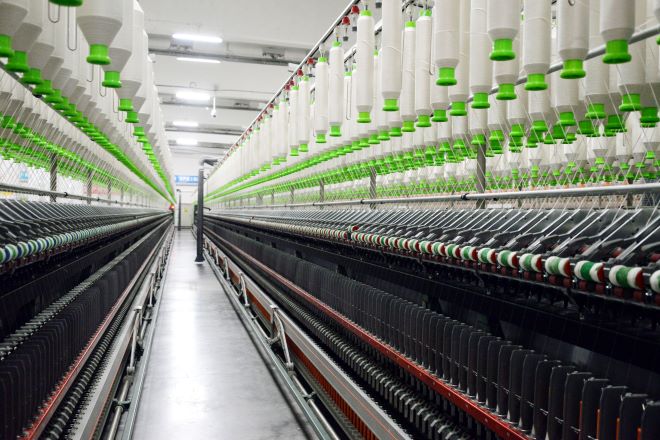
A customer in Hubei tried our ethylene antimony PET chips in 2022. They run an 80,000-ton/year filament line.
Three months later, they told us:
“Before, 4 to 5 out of every 100 positions broke. With your chips, breakage is just 1.3%. It’s worry-free.”
More benefits they saw:
- Breakage down 70%, from 4.5% to 1.3%.
- Spin speed up 200 m/min, especially stable at high speeds.
- Spin temp down 5–8°C, saving energy.
- No color deviation batches in three months.
- Less stretch breakage, better final moisture control.
3. Why Can We Do This?
Ethylene antimony has three key advantages:
- High solubility: Fully dissolves in EG, gives uniform reaction.
- High activity: Cuts poly time, makes more regular polymer chains.
- Low impurities: No free Sb migration, purer chips, better spinnability.
We also use a two-stage precision filtration system. Sb, Ti, and heavy metals are all kept within ±5 ppm. We also run online IV and laser particle monitoring.
4. Final Words
Catalyst choice affects more than just PET reaction. It affects the entire spinning chain.
We know what matters to spinning plants: less downtime, less waste, better yield. That’s why we use ethylene antimony — for faster reaction, smoother spinning, and better fabric.
We’re not just selling PET chips. We help spinning mills reduce cost and improve output — from the very source.
Want samples or tech specs? Contact us. Let’s optimize every spinning line, together.



One Response
What is Ethylene Antimony catalyst ?
Can you explain more about it and its structure & impurity level %?